

Chongqing Homar Technology Co., Ltd. is a supplier specializing in the design, manufacture and distribution of hand tools and hardware products. The main products include various pliers, hammers, wrenches, garden tools, construction tools, and safety tools. Our products have been exported to more than 80 countries and regions around the world, which are produced under strict quality control, and with relevant certificates and test reports.
Rich Experienced
Our more than 80 partners have many years of experience in product manufacturing and marketing, and can promptly connect, follow up and provide feedback on any of your product needs. Here you can find wholesale hand tool kits in various sizes and specifications and get customization services.
High Productivity
Our factory covers an area of more than 200,000 square meters and contains 6 production lines. It can supply your products as quickly as possible and provide expedited logistics and transportation services.
Quality Assurance
Our factory production process has passed ISO 9001: 2008, IS09001: 2000, ISO14000 and other certifications. Our products basically comply with EN standards, ANSI and other standards.
Wide Product Range
Our product range is complete, including hammers (claw hammer, ball hammer, rubber hammer), pliers (wire cutters, needle nose pliers, wire strippers, pipe wrench), measuring tools (tape measure, tape measure, belt ruler, ruler), as well as other hardware tools.
-
![Carbon Steel End Cutter Pliers]()
Carbon Steel End Cutter Pliers
Add to Inquiry -
![Multi-function Combination Pliers for Fishing]()
Multi-function Combination Pliers for Fishing
Add to Inquiry -
![Multi Purpose Diagonal Plier]() Add to Inquiry
Add to Inquiry -
![Multi-purpose Combination Plier]()
Multi-purpose Combination Plier
Add to Inquiry -
![Multi Purpose Long Nose Pliers]()
Multi Purpose Long Nose Pliers
Add to Inquiry -
![6 Inch Slip Joint Pliers]() Add to Inquiry
Add to Inquiry -
![snap on needle nose slip joint pliers]()
snap on needle nose slip joint pliers
Add to Inquiry -
![Combination Slip-Joint Pliers]() Add to Inquiry
Add to Inquiry -
![heavy duty diagonal cutters]() Add to Inquiry
Add to Inquiry -
![snap on diagonal pliers]() Add to Inquiry
Add to Inquiry -
![heavy duty long nose pliers]() Add to Inquiry
Add to Inquiry -
![Joint Combination Pliers]() Add to Inquiry
Add to Inquiry


Pliers are a hand tool used to hold objects firmly, are also useful for bending and physically compressing a wide range of materials. Generally, pliers consist of a pair of metal first-class levers joined at a fulcrum positioned closer to one end of the levers, creating short jaws on one side of the fulcrum, and longer handles on the other side. This arrangement creates a mechanical advantage, allowing the force of the grip strength to be amplified and focused on an object with precision. The jaws can also be used to manipulate objects too small or unwieldy to be manipulated with the fingers.
Features of Pliers
Sturdy Construction
Our pliers are made from durable nickel-chromium steel and are case-hardened to ensure a sharp, long-lasting cutting edge and provide maximum grip strength while in use.
Comfort Grip
Their ergonomic grips are covered with thick rubber to provide a comfortable grip and prevent hand fatigue during long hours of work.
Rich Sizes
Our pliers are available in a variety of sizes and shapes from regular to custom, including 8 x 9, 10 x 11, 16 x 18, 17 x 19 mm and more. We carry the sizes you often need. Sizes are permanently stamped on both ends of the wrench for easy identification.
Easy to Operate
These wrenches feature multiple tooth gears and a full drive box end, providing a stronger bite and twist function to easily tighten and loosen any bolt or nut.
Application of Pliers
Gripping
The primary use of pliers is for gripping. You can use them to loosen or tighten bolts, grip objects for stability, or pull out pins, nails, or other fasteners.For example, slip joint pliers are a utility pliers designed for gripping and transmitting torque. They have relatively flat jaws with teeth for gripping small objects and a rounded, toothed opening for gripping larger objects, such as bolt heads and nuts.Many pliers also have a small scissor-like section for cutting wire. Tenon pliers work similarly to multi-purpose pliers, but have long handles and offset or angled jaws for improved leverage. The jaws are height adjustable and can open wide to grip pipes and large nuts.
Bending/Straightening
The pliers can also be used for bending or straightening. The cross brace of pliers gives them superb torque power to bend and twist objects such as sheet metal, nails and wires.All pliers can help bend things, so the kind you choose depends largely on the specific object you need to bend. Long-nose pliers or needle-nose pliers help you grip small objects that may be difficult to reach. Electricians usually use lineman's pliers to bend wires and cables.
Cutting
Some pliers can also cut wires and nails. Diagonal cutting pliers and side-cutting pliers, often called wire cutters, are primarily used to cut and sever wires. In most cases, their jaw construction makes wire cutters less suitable for gripping large objects, such as bolts. However, they are still considered pliers because of their ability to effectively grip and remove nails.
Splicing Wires/Stripping Insulation
Electricians use a variety of special pliers to splice wires and strip insulation. For this task, lineman's pliers are a popular choice. Using the wire cutter feature, you can cut through the insulation of one wire and strip off a small section to reveal the bare wire inside. If you do the same thing to another wire, you can use the pliers to help join or splice the two wires together.
Main Types of Pliers



Combination Pliers
If you wish to enter the field of DIY but have no idea which pliers to use, prepare combination pliers first. Combination pliers, also known as linesman pliers, are actually a versatile working tool because they have two of the most fundamental features of pliers: cutting and gripping. They can also handle bending, stripping, and twisting. The jaws are square and serrated and usually have a blade (for some models, also the pipe grip) between the head of the jaws and fulcrum.Combination pliers and linesman pliers are considered to be synonymous for convenience’s sake, but there are some key differences between them. Linesman pliers are more likely to have thicker and heavier jaws while combination pliers have narrow and thin jaws, though this varies between brands.
Slip Joint Pliers
Slip joint pliers are another all-rounder tool that most DIYer and engineers use in their work very often. As the name indicates, this type of pliers features an adjustable pivot point that allows their jaws and pipe grip to open wider according to the object to be gripped. Along with this basic function, slip joint pliers can be useful in holding, bending, crimping, and cutting. With their flat and serrated jaws, you can even use the slip joint pliers to tighten or loosen nuts and bolts.
Water-pump Pliers
Water-pump pliers, also known as tongue-and-groove pliers and multi-grips, basically have the same core functionality as slip joint pliers. However, the largest difference between water-pump pliers and slip joint pliers is that the former have a wider range of jaw opening than slip joint pliers, so they are suitable for holding thicker objects like a pipe. Also, unlike slip joint pliers, the water-pump pliers have an angled head to facilitate access to the pipe located in a smaller space. Besides plumbing work, the water-pump pliers can also catch and remove screws.
Needle Nose Pliers
Needle nose pliers have similar functions to those of combination pliers, but with their tapered, long, and conical jaws, they are ideal for operations in less accessible areas where other pliers cannot reach. This type of pliers can also handle holding, placing, bending, and cutting when equipped with side cutters. For workers who engage in delicate tasks including jewelry making, electric work, and radio/TV jobs, needle nose pliers are their staple instrument.Needle nose pliers have two types of head: straight nose and bent nose. The bent nose pliers are another variation of the needle-nose pliers that have their tips bent at an angle between 45° and 90°. With this feature, they can reach into narrow spaces even if there are a large number of obstacles.
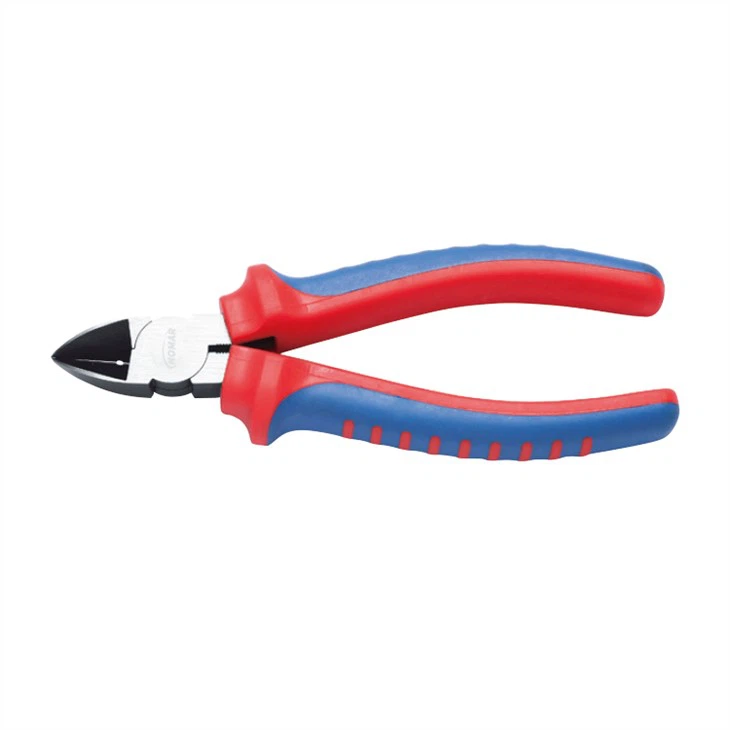
Diagonal Pliers
Usually called a nipper in Japan, diagonal pliers (also termed as cutting pliers) are said to be an essential tool for those who conduct electric works and carpentry. These pliers usually have compact bladed jaws that are angled diagonally and longer handles to get more leverage. As a result, they can cut through copper wires, steel wires, and VA/VFF wires while some can even cut piano wires and thin nails or screws. However, when using diagonal pliers, there are two things you should bear in mind: do not cut objects whose toughness and thickness are beyond the pliers’ capacity; and do not cut a live wire even if it is insulated.
Locking Pliers
There may be a case in which you wish to seek additional manpower to hold a certain object while operating other tasks at the same time, and in such a situation, locking pliers (also known as Vise-grip pliers) will be helpful. Locking pliers are designed to firmly lock the object without the assistance of a human hand. There is a screw drive to adjust the jaws’ opening width at the end of the handle, and you need to adjust it by dialing it. Although this requires some practice to achieve the desired adjustment, you can effortlessly lock and hold objects with greater strength once you master it.
Crimping Pliers
The crimping pliers, also called wire crimpers, crimping tools, or crimpers, are unfamiliar to ordinary DIY practitioners, but they are one of the must-have tools for electricians. These are used for handling plugs when installing network connections. They can be used for various types of cables including LAN cables, fiber cables, TV cables, and more, and for this reason, these pliers are often used in the fields of networking and communications.
Snap Ring Pliers
A Snap ring is a small metal ring that is set in a bearing: a part that supports rotating shafts in vehicles, generators, household appliances, etc. Snap ring is installed in parts like grooves, bores, and shafts to prevent these from slipping out, so it plays the role of a fastener. To insert or remove the ring, you need to use snap ring pliers.
Wire Strippers
Mainly used by electricians and some DIYers who often conduct wiring tasks, wire strippers remove insulation, which is a protective coating of an electric wire. They usually look like a combination of needle nose pliers and diagonal pliers. Wire strippers usually have a series of holes with different gauges located between the tip of the jaws and fulcrum, and users should match the size of insulated wires with those described on the jaws. The other functions often added to wire strippers are flat and serrated jaw tips for gripping, twisting, and pulling, and a side cutter for cutting thin objects.
Fencing Pliers
They can be used as a hammer but actually are a multi-functional tool to cover all necessary tasks for erecting or maintaining a fence. In general, fencing pliers can be used as a cutter, hammer, and remover for staples (a U-shaped metal loop which is driven in a pole and the like to fix a wire). Unlike most pliers, the pliers for cutting fencing are located on the fulcrum and can cut thick wires. One side of the jaws resembles the head and neck of the hammer, and you can drive staples as if you were using the real hammer.
Factors to Consider When Choose Pliers
There are a lot of cutting pliers in the market to choose from. They come in different forms and sizes. However, there are cutting pliers that cut hard wires or thick cables better than the others. These tools are what you may need to look for. You may check how wide their jaws are. You may look into their sharp blades too and determine whether they could slice through multi-layered wires.
Aside from the pliers’ ability to cut through hard and thick lines or wires, you may look if they’re capable of slicing through an object efficiently as well. Aside from the blades, you may consider the metal or steel quality. Also, it’s advised to check the pliers’ grips span and select the type with 6-9cm to avoid cutting accidents.In addition, you may look into the pivot point. This part should easily move sideways when gripped or un-gripped for better locking. This way, you’d be sure that you’ll cut wires evenly and well. In some cases, you may use your pliers in cutting metal strips or hard components that may be challenging to rip off. If your chosen tool can cut through these materials, they’re likely to slice similar objects.
Although maintenance is your job to ensure your tools’ excellent performance and extended lifespan, it’d be better if the pliers were easy to use and maintain. If the pliers need simple gripping and slight pushes, you’re less likely to have troubles with their use. In addition, you could avoid untoward cutting that may come along with its use.In maintenance, you may prefer pliers that are easy to clean with just by merely wiping and oiling them. In addition, you may check if the pliers have an excellent return spring as it’s one of the parts that usually dislodge. If you want to properly maintain your cutting pliers, you could keep them in a toolbox.
You may look into the durability of the tool through its hardness level. In many cutting pliers, the standard is pegged at HRC 64. The blade’s sharpness also has something to do with the general durability and pivot joint strength. It’s believed that the sharper the blades are, the more durable the tool is as it won’t need extra force when cutting.In addition, you may check on the general performance of the pliers when repetitively used. You may choose the type that requires minimal effort yet provides better performance. Lastly, look into the tool’s body if it’s prone to cracking or chipping and other damages.
Process of Pliers
Forging: This is the most important process that decides the quality of the product. By the fine-tuned checking of product quality, if there are products with poor quality, we immediately stop production to prevent poor-quality products from being sent to the next stage of the process. Additionally, when there are requests from the post-process, we always improve the forging to meet such requests.
Drilling: First, the metal is machined to make it closer to the shape of a final product. You might think it’s nothing but pliers. We drilled a small eye to fix the pliers. This is very important, a little difference will affect the coordination of the entire pliers.
Rough scraping: Producing roughly form a metal casting into the shape of a plier via machine.
Forming: Gradually have the appearance of pliers.
Fine scraping: Scraping the pliers further to make it more refined.
Assembly: After combining the right and left parts by inserting a pin, the operator manually makes adjustments. For the first time, the metal is formed into a pair of pliers. In this process, the left and right parts, sent separately from the machining process, are assembled into a single item. Since this process is the groundwork for the post-process, the operator checks each pair of pliers, individually, to make sure there is absolutely zero mis-alignment when the left and right parts are assembled, making delicate adjustments, if necessary.
Crating blade: Crating a blade from the original metal casting head according to the technical specifications.
Precise drilling: Drill a considerable eye so that the rivet can be stamped.
Riveting: Stamping rivets make the pliers firm and stable.
Grinding: Grinding the surface of the pliers with a grinding wheel.
Quencing: After quenching the entire part, the operator applies high-frequency induction quenching to increase the hardness of the tips. The operator applies quenching equally to the left and right blades to increase the hardness, in order to produce highly durable blades of equal hardness. However, if the metal is too hard, it becomes rather brittle. Therefore, we check the products with rigorous standards, by conducting tests on body hardness, blade hardness and impact resistance.
Blade Sharpening: This process decides the cutting sharpness, which is the most important for all types of pliers. We cut using the bottom ends of the blades, in the case of side cutting pliers, while we cut using the top ends of the blades, in the case of nippers. Therefore, the operator manually sharpens the edges of blades, one by one, by thinking about how to use products.
Polishing: In this finishing process, workers will polish products carefully. This process will not affect the function of the product. However, if a product has a poor appearance, customers will not pick them up from the shop counter.
Cleaning: Use ultrasonic cleaning pliers to have a clean surface.
Quality Inspection: When products go through the production processes, individual parts sometimes have various delicate misalignments. The operator carefully makes manual adjustments to correct such delicate misalignment.
What You Should Know When Use Pliers
No matter what it is you’re doing, safety always needs to come first. This includes pliers – from lineman pliers for electrical work to screw extraction pliers and everything in between. It might not seem that pliers would be particularly hazardous, especially if you compare them with other tools like drills, saws, and power tools, but don’t be deceived: if you don’t pay attention and take care, pliers can certainly cause harm to you, another person, or the materials you are working with.
●Always protect your eyes! When you are cutting wire, or removing a stripped screw, or doing any other work with pliers, debris can fly into the air and into your face. Wear protective goggles or glasses each and every time.
●Only use pliers for their intended job. Never use pliers in place of a hammer, shears, or any other tool – they have their own purpose. Using them incorrectly and for the wrong application can damage the pliers and also cause accidents.
●Use the correct pliers for the job at hand. This means using only designated wire cutting pliers for cutting wire; needle-nose or long-nose pliers for tight spaces; and screw extraction pliers for removing damaged or stripped screws.
●Never force pliers. Pliers come in varying levels of capability, and this is why you should have a set of pliers rather than a single pair that you use for every job. Some pliers are specifically intended for light tasks only, while others suit heavy duty use. Forcing pliers beyond their capability may result in them breaking or springing.
●Don’t expose your pliers to excessive heat. Even the sturdiest pliers are sensitive to very high levels of heat, and they will become damaged, possibly beyond repair, if they are exposed to an open or direct flame or otherwise very high temperatures.
●Only cut with designated cutting pliers and only at right angles to the wire. Don’t rock the pliers from side to side to affect a cut! This may nick the cutting edge of the pliers and will eventually make them blunt.
●Never ever use pliers – even electrician’s lineman pliers – on live wires. This is not safe under any circumstance. Only a professional and qualified electrician should ever work with live electricals.
●To keep your pliers in prime condition, add a drop of oil at the joint of the pliers periodically. It will keep them opening and closing smoothly and help prevent rust and corrosion.
Our Certificate Photo

Our Factory Photo

Frequently Asked Questions of Pliers
Q: What is the function of cutting pliers?
Q: What are cutting pliers called?
Q: What is the difference between cutting pliers and scissors?
Q: Can you cut things with pliers?
Q: How do you keep pliers clean?
Q: Why are pliers called a pair of pliers?
Q: Which pliers are not for cutting?
Q: How do you properly grip pliers?
Q: What are the limitations of pliers?
Q: What is the most common size of pliers?
Q: What are diagonal pliers used for?
Q: What are channel-lock pliers used for?
Q: What is the difference between diagonal and side cutting pliers?
Q: How do you properly maintain pliers?
Q: How does the design of pliers differ based on their intended purpose?
Q: Can cutting pliers cut through metal?
Q: Are pliers holding tools?
Q: What common mistakes are made when using pliers?
Q: What is the risk of pliers?
Q: What is the strongest part of pliers?
We're professional pliers manufacturers and suppliers in China, specialized in providing hand tools and hardware. We warmly welcome you to buy high quality pliers in stock here from our factory. Contact us for more details.
Rattan Style Outdoor Storage Box With Hinges 450l, Claw Hammer With Tpr Handles, Carbon Steel Locking Pliers